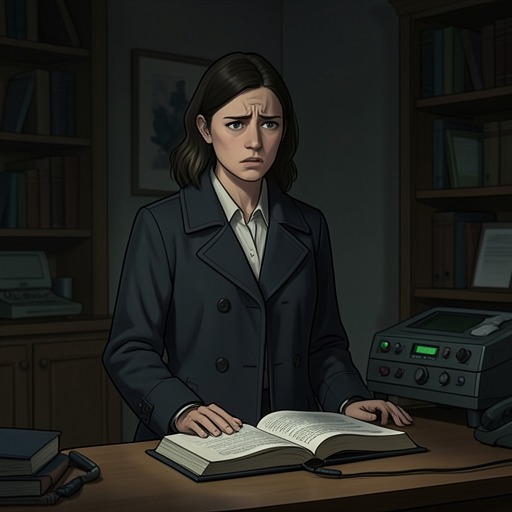
Prophecy and precognition
The RookProphecy and precognition sit uneasily between Checquy skepticism and the possibility of exact knowledge: most alleged psychics are dismissed as frauds or interpreters of meaningless riddles, yet Lisa Constanopoulos and a tested oracular duck give Myfanwy Thomas warnings that materially reshape her understanding of what is coming. The predictions do not grant control over the future. Instead, they make danger legible while leaving its timing, causes, and full consequences beyond reach.
Institutional Skepticism and the Search for an Oracle
The Checquy encounters precognitives, psychics, and fortune-tellers often enough to have formed a dismissive view of them. Their prophecies, as Myfanwy describes them in a letter to her successor, tend to rhyme without scanning and rely on metaphors so obscure that they cannot be understood; other claimants merely give their epilepsy a grander meaning. The organization nevertheless considers itself obliged to keep looking. Its skepticism is practical rather than absolute: the possibility of genuine foresight remains important enough to investigate, even when experience has made belief difficult.
That distinction explains the prolonged search for an animal reputed to see the future. The Checquy reasons that an animal would be less likely than a human psychic to fake its ability for attention, and assigns agents to pursue leads throughout the kingdom. The investigation consumes substantial money and outlasts several generations of agents. Its parade of supposed discoveries—swine, a goat, a rabbit, a Jack Russell terrier, and a cardboard box said to contain the prophetic snails of Beccles—makes the search a recurring source of embarrassment rather than reliable intelligence. None of the animals demonstrates foresight, and Myfanwy inherits the effort when she becomes Rook because it is one of Sir Henry Wattleman’s longstanding obsessions.
The search finally produces an animal the Checquy’s leading scientists have tested and confirmed as prophetic. Myfanwy arranges a Court dinner at the Rookery to present the United Kingdom’s only oracular duck. The grand institutional occasion meets a comically unceremonious subject: when Myfanwy tries to make conversation, the duck defecates on the table. That irreverent introduction gives way to a more consequential demonstration. Asked through a computer keyboard whether Checquy operatives will attack her, the duck straightens its neck and pecks the Y key. Its method is limited but legible: it answers questions with a visible yes or no, unlike the metaphor-laden human prophecies the organization distrusts.
Lisa Constanopoulos’s Warnings
The warnings that frame the duck’s demonstration come from Lisa Constanopoulos, whose predictions speak not in test results but in images of betrayal, death, and rain. At a meeting with Myfanwy, Lisa tells her that a member of her Court will betray her. She presents the danger as something both of them already know, and sees Myfanwy standing in the rain among dead men. When Myfanwy asks how she knows, Lisa answers that she sees it clearly, holding Myfanwy’s hands with a grip at once firm and controlled.
Lisa’s prediction becomes more ominous when the encounter ends at her hotel suite. As Myfanwy says goodbye, Lisa grips her wrist, draws her close, and whispers that very bad things are approaching—among the worst she has seen. She warns that Myfanwy will lose everything and end in the rain, then admits that she cannot see beyond that point. The limit matters as much as the certainty: Lisa offers no explanation of how the betrayal will occur or what follows the rain. Her vision marks an edge in knowledge rather than a map through events.
The contrast between Lisa’s intimate, insistent delivery and the duck’s mechanical answers does not make one warning simply more credible than the other. Lisa’s vision carries a broad, emotionally charged picture but an uncertain horizon; the duck makes narrow predictions that can be recorded as Y or N. Both forms of precognition leave Myfanwy with information she cannot yet use to identify the full circumstances of the threat. Foreknowledge in this story is therefore not mastery: it is the burden of recognizing danger before knowing how to prevent it.
The Duck’s Three Answers
Myfanwy asks the duck three questions, using the small number available to her as an opportunity to plan. Its first answer confirms that Checquy operatives will attack her, a prospect she has already heard predicted by a schoolboy, a homeless man, and an oracle described as thirty-seven hundred years old. The answer is not entirely new, but the duck’s rapid, direct response gives the warning a different authority. Myfanwy sees the encounter as a rare chance to gain an advantage, not merely as a spectacle for the Court.
The second answer narrows the threat. Asked whether she will be attacked in her house, the duck selects N. Myfanwy feels relief: she had imagined being dragged from sleep or watching her rabbit killed, and the negative answer lets her set those particular fears aside. It does not cancel the first prediction. The attack remains expected; only the house is ruled out. The exchange shows how a precise answer can relieve one anxiety while leaving the larger danger intact.
For her final question, Myfanwy asks whether she will lose her memory within a month. The duck answers Y. That prediction connects the animal’s reading to Lisa’s warning that Myfanwy will lose everything, but now supplies a deadline: weeks at most. Myfanwy covers her face for a full minute while the duck sits quietly beside her. She had assumed there would be time to prepare, because she did not know when the loss would come; the answer forces her to recalculate her schedule under a new and urgent constraint.
Foreknowledge, History, and Political Risk
The book places these personal predictions against the Checquy’s longer history of supernatural conflict, where uncertainty about an adversary’s capabilities also shapes decisions. In 1677, monsters emerged from the ocean and the Checquy fought the Grafter invasion on the Isle of Wight for three weeks, with hundreds of civilians killed. The surviving account emphasizes the cost of discovering the enemy’s strength in battle: each Grafter creation required dozens of Checquy soldiers to bring down. The eventual death of the Grafter general at the cost of Crimson Rook John Perry’s life ended the incursion, but it did not mean the Checquy understood the danger in advance.
After the invasion, the Checquy concealed its own decimated condition while negotiations with the Belgian ruler produced an agreement to dissolve the Grafters. The rulers accepted the settlement partly because they feared the Checquy’s apparent military superiority, while the Checquy’s leaders knew that their forces and most capable generals had been devastated. This history gives later claims of foresight and hidden intent a political resonance: what an organization can see, what it assumes, and what it chooses to disclose are not the same. Centuries later, Graaf Ernst von Suchtlen describes the old invasion as a feint, not a plan to conquer England, and says the Grafters instead sought leverage over the Checquy’s secret world.
Ernst also explains that resentment after the Checquy’s destruction of the Grafters gradually gave way to forgiveness and a hope for cooperation. His account of infiltration and collaborators recasts actions that could look like preparation for renewed violence as an effort to make the Checquy consider union, while leaving the possibility of force in view if the Grafters’ continued existence were threatened. Against that background, precognition’s promise of certainty remains partial. A vision can reveal betrayal or a deadline, but neither the individual nor the institution is spared the work of interpreting what the warning means and choosing what to do with it.
The Cost of Knowing
The predictions gather around a central reversal: Myfanwy has sought useful intelligence about threats to her body and home, but the answer that most changes her immediate plans concerns the loss of her own memory. The duck does not tell her who will bring that loss about, what it will erase, or what she can do to stop it. Lisa’s vision is broader but ends at the same boundary of incomplete knowledge. Their warnings make an approaching rupture undeniable without making it fully intelligible.
The oracular duck’s role also exposes the Checquy’s tension between disbelief and institutional need. The organization has spent years chasing false leads, recording failures, and maintaining an inquiry Myfanwy would have abandoned if it were not Wattleman’s obsession. Yet when an animal finally proves predictive, its answers matter not because they resolve uncertainty but because they make uncertainty actionable: no attack in the house, an attack by Checquy operatives, memory loss within a month. Prophecy provides a few hard edges against an otherwise unreadable future, and the space between those edges remains where judgment, fear, and preparation must operate.